Choosing the best camera from the thousands on the market can be tricky at the best of times, and this is particularly true if you’re looking for cameras for self-portraits.
That’s because taking self-portraits (whether artistic, travel, or other kinds) is more of a niche pursuit compared to popular photography genres such as landscape, wildlife, or street photography.
Thus, there aren’t that many camera reviews specifically for self-portrait photography out there.
As a professional self-portrait photographer, I have tried many different cameras and know exactly what features to look for when buying one.
In this blog post, I’ll give you a roundup of the best cameras for self-portraits in 2026 and some general tips for choosing one.
(This post contains affiliate links. As an Amazon Associate/partner of other affiliate programs, I earn from qualifying purchases.)
1) Full Frame Cameras
First, let’s talk about full-frame cameras.
These are more expensive than crop-sensor cameras but offer many advantages, such as higher resolution or better performance in low light.
Here are my three favourite full-frame cameras for self-portrait photography.
1.1 My Top Pick: Alpha 7 IV
I just love this camera!
First, it’s mirrorless, which makes it compact and light.
Also, I do think that mirrorless cameras have slightly better autofocus (very important for self-portraits) than DSLR cameras due to their advanced technology.
Next, it’s a full-frame camera, meaning you get extremely high image quality (great for in-depth editing and printing).
Top Features of This Camera
The Sony 7 Alpha IV’s best feature is its excellent autofocus.
When taking self-portraits, it’s best to set the camera to autofocus with face recognition or eye tracking so that you get sharp images of yourself.
The autofocus in the Sony Alpha 7 IV is incredibly reliable, and my images are usually ultra-sharp.
For comparison, my previous camera was the Nikon D750, a DSLR, and its autofocus was much less reliable; I don’t think the images were as sharp even when I got the focus right.
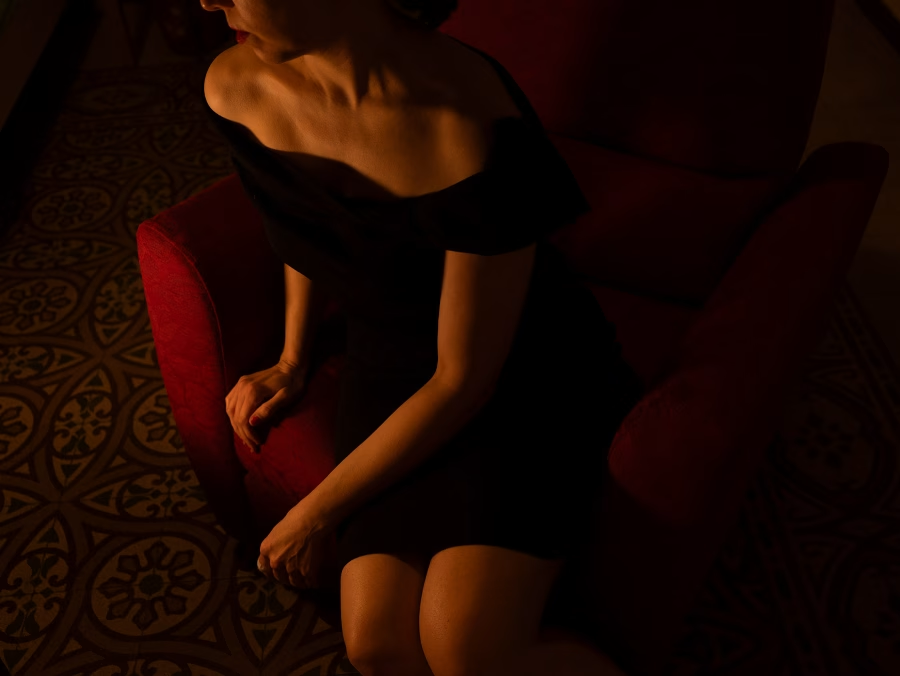
Self-Portrait Taken with the Sony Alpha 7IV
Other Great Features
Another great feature of the Sony Alpha 7 IV is its Bluetooth/Wi-Fi compatibility:
This means you can control it through an app on your phone, which is great for taking self-portraits and setting the focus on your phone screen.
This camera also has excellent video quality, meaning it would be a great choice for content creators and YouTubers!
What I Don’t Love
For me, the only negative I’ve found so far in this camera is that it doesn’t have an in-built flash.
I don’t use flash very often, but it would be nice to have it as a feature nonetheless.
My workaround for this is an additional speedlight that I can pop on when needed.
Buy the Sony Alpha 7 IV here:
Recommended Lens
My favourite lens for this camera is the Sony E-mount FE1.8/50 mm prime lens. Here is an image taken with this lens:
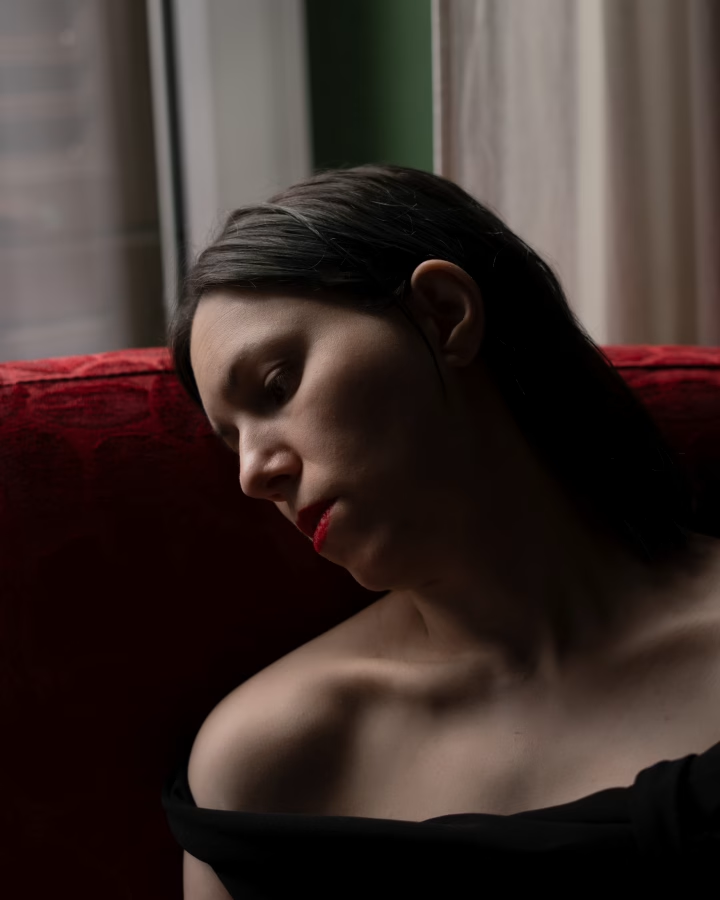
At its largest aperture, it produces a beautiful shallow depth of field and is great for low-light settings.
1.2 Full-Frame Alternative 1: Nikon Z5 II
My next full-frame pick is the Nikon Z5 II.
This is actually a significant update from the Nikon Z7 II I previously recommended in this post, and I think it’s an even better choice for self-portrait photographers.
The Z5 II has a 24.5-megapixel full-frame sensor and Nikon’s latest autofocus technology, including excellent subject and eye detection.
Another feature I really like is the fully articulating screen. You can flip it around to face yourself while shooting, which makes checking your pose and composition much easier.
You can also connect the camera to your phone for remote shooting.
Overall, the Nikon Z5 II is an amazing option if you want to move into full-frame photography without spending quite as much as you would on some higher-end professional cameras.
Top features for self-portraits:
- 24.5MP full-frame sensor
- excellent eye/subject-detection autofocus
- fully articulating touchscreen
- smartphone connectivity for remote shooting
- good low-light performance
- in-body image stabilisation
Buy the Nikon Z5 II here:
1.3 Full-Frame Alternative: Canon R6 Mark III
If you’re a Canon fan, I’d recommend the Canon EOS R6 Mark III.
This full-frame mirrorless camera has a 32.5-megapixel sensor – a nice increase from the 24.2 megapixels of the previous R6 Mark II.
More importantly for self-portrait photographers, it offers excellent autofocus with eye detection.
The R6 Mark III also has one of my favourite self-portrait camera features: a fully articulating touchscreen that you can flip around to face yourself while shooting.
Of course, you can also connect the camera to your phone for remote shooting.
Overall, this is a great all-round camera for both photography and video, and an especially good choice if you’re already invested in Canon’s RF lens system.
Top features for self-portraits:
- 32.5MP full-frame sensor
- eye-detection autofocus
- fully articulating touchscreen
- in-body image stabilisation
- excellent low-light performance
- great photo and video capabilities
Buy the Canon EOS R6 Mark III here:
By the way…If you enjoy taking self-portraits, you might like my free ebook with 50 self-portrait ideas:
Free Ebook-50 Self Portrait Photography Ideas
Do you love self-portrait photography, but lack inspiration for your shoots? Then download my e-book with 50 ideas for self-portrait photography!

…but now, back to the blog post!
2) Crop-Sensor Cameras
Next, let’s talk about crop-sensor cameras, also called APS-C cameras.
These cameras have a smaller image sensor than full-frame cameras, which can lead to disadvantages, such as lower image quality in low-light conditions.
Consequently, they are much more affordable than full-frame cameras and are still an excellent option, particularly for beginners or those on a budget.
Just like with the full-frame cameras mentioned above, I have included crop sensor cameras from Sony, Nikon, and Canon below, as I know that many people tend to favour one brand over the others.
Here are my top selections for APS-C self-portrait cameras.
2.1 My Top Choice: Sony Alpha 6700
Again, I placed a Sony camera at the top of my recommendations.
That’s simply because I love Sony cameras!
I used to be a huge Nikon fan, but since switching to Sony, I’ve really fallen in love with the brand. (I’m not sponsored by them, unfortunately :-).
Anyway, the A6700 is a crop-sensor camera with 26 megapixels.
It has a great subject detection autofocus, which also works well in lower light.
Like every camera on this list, the Sony A6700 has Bluetooth and Wi-Fi connectivity, which means you can control it remotely through a phone app.
Overall, this is a great crop sensor option for any self-portrait photographer:
2.2 Great Alternative: Canon EOS R10
This is another great crop sensor camera for self-portraits.
The Canon EOS R10 has 24.2 megapixels and reliable autofocus.
Of course, it’s also compatible with Wi-Fi and Bluetooth so that you can take your shots remotely via the phone app.
It’s also light and offers many lens choices. By the way, this camera is also great for vlogging!
3) Best Budget Option
If you’re on a budget right now, try this option to get started:
Sony ZV-1 II
I really love this little camera!
Like its predecessor, the Sony ZV-1 II is primarily aimed at content creators, which actually makes it a great option for self-portrait photographers: many of the required features are exactly the same, including a flip screen and reliable autofocus.
The camera features a 20.1MP 1-inch sensor and an 18–50mm equivalent zoom lens, giving you a particularly wide field of view.
This is very useful when you’re taking self-portraits in smaller spaces or want to include more of your surroundings.
The touchscreen flips around so you can see yourself while shooting, while Sony’s subject-recognition autofocus can automatically detect and focus on your eyes.
It’s also compact and super light, making it a great choice if you don’t want to carry a larger mirrorless camera around.
Finally, the ZV-1 II has built-in Wi-Fi and Bluetooth and works with Sony’s Creators’ App, allowing you to control the camera remotely from your smartphone.
You can buy the camera here:
Before I get to the next section…did you know I’ve written an in-depth self-portrait photography guide? More info below:
My Ebook: The Self-Portrait Guide!
Would you like to learn more about self-portrait photography? Then check out my ebook now! Topics include:
- how to use natural and artificial lighting
- essential gear you’ll need for self-portraits at home
- idea-finding techniques to develop concepts for photo shoots
- how to edit, export and print your images, and more!

…but now, onto the next section: general tips for choosing a self-portrait camera.
4. General Tips for Choosing a Self-Portrait Camera
In this section, I wanted to give you some general tips and guidance for buying self-portrait cameras, like whether you should get a DSLR or mirrorless camera or what features to look out for.
4.1 Mirrorless vs. DSLR
First of all, you may wonder whether you should buy a DSLR or a mirrorless camera.
I actually used to be a huge fan of DSLR cameras and was always a bit sceptical about getting a mirrorless.
And while I do think that DSLR cameras have some advantages, I have now switched to mirrorless cameras for two main reasons:
First, DSLR cameras are slowly being phased out by manufacturers in favour of mirrorless cameras, so it’s going to be harder and harder to find lenses and other accessories for DSRLs.
Secondly, and more importantly, I’ve noticed that mirrorless cameras have superior autofocus to DSLRs.
As mentioned before, autofocus is one of the most important features for self-portrait photographers, as you cannot physically be behind the camera and manually focus on yourself.
Hence, if you’re still on the fence about getting a DSLR or mirrorless camera, I highly recommend you switch to mirrorless.
This is also why all the cameras in this list are mirrorless, as well.
4.2 Connectivity Options
Next, ensure that your camera has Wi-Fi or Bluetooth connectivity and that the brand offers a phone app for remote shooting.
This is the number-one feature for self-portrait photographers because it makes taking the shot so much easier.
You can hold your phone and focus on the screen; it’s basically a remote control for your camera, helping you take sharp photos every time.
4.3 Eye-Detection/Face Detection Autofocus
The next essential feature for self-portrait cameras is eye-detection/face-detection autofocus.
As mentioned, self-portrait photography requires you to be physically present behind the camera, so you need a camera that can help you focus.
I used to own a Nikon D750, which is a great camera in many ways, but its autofocus wasn’t very reliable.
Since I switched to the Sony Alpha 7 IV, which has amazing eye-detection autofocus, I have had no more issues with blurry images.
4.4 High Image Resolution
Next, invest in a camera with the highest image resolution you can afford.
Higher resolution means more pixels, which will lead to finer details being captured.
In addition, a higher resolution leads to better print quality:
High-resolution images can be printed in larger sizes without appearing pixelated or blurry.
4.5 Nice-to-have Features
There are some additional “cameras for self-portraits” features that will make taking self-portraits much easier.
Flip Screen
The first is a flip/vari-angle screen that you can flip to face the front.
This will help you with image composition, as you can see what you’re doing on the screen.
Good Battery Life
Another helpful feature for cameras for self-portraits is a long battery life, especially if you use studio flashes or other artificial lighting that is synced with your camera.
Taking self-portraits is hard enough as it is, and it can be very annoying to change the battery mid-shoot.
Hence, a battery that gives you more shots per charge is definitely useful.
Good Low-Light Performance
I used to shoot with the Nikon Z 30, a compact, entry-level mirrorless camera.
I was happy with it overall, but it didn’t deliver great results in low light.
This was a shame because I did one particular shoot with only natural street lighting. The photos were beautiful, but unfortunately, there was a lot of noise.
A camera with better low-light performance, like my Sony A7 IV, would’ve delivered much better results
Therefore, if you can, invest in a slightly more expensive camera with better low-light performance.
Hopefully, you now have a better idea of what to look out for when buying cameras for self-portraits.
If there’s any camera you particularly love, make sure to mention it in the comments section down below!
And finally, check out my newest book specifically aimed at getting you shooting more and taking more creative, interesting self-portraits:
Get Fresh Inspiration For Your Self-Portrait Photography
Discover new ways to approach self-portrait photography through creative prompts exploring symbolism, storytelling, painterly techniques, mixed media, and emotion.