
Failsafe Strategies for Reaching Your Photography Goals
For many people, goal setting is one of those topics that sound incredibly dry – like “filing a tax return” or “taking out insurance”.
This is especially true for creatives such as photographers:
What you WANT to do is take beautiful photos, not get bogged down by tedious admin tasks such as “setting goals”, a task more commonly associated with workshops and seminars.
However, I’m a firm believer that if you want to get anywhere in life, you need to know your destination – even in creative pursuits such as photography.
Of course, if you’re happy to just potter along and take occasional snaps whenever you feel like it, you don’t have to obsess over goal setting.
But chances are, if you’ve found your way to this blog, you’re passionate about photography and want to improve your photography skills or maybe even start your own photography business.
In that case, having a clear plan will make your journey so much smoother and help you accomplish all of your photography goals.
In this blog post, I’ll discuss why we often fail to reach goals.
I will also share how to best set photography goals and how to make sure you achieve them without feeling frustration or overwhelm.
Let’s dive in!
Why We Often Fail to Reach Goals
I cannot tell you how many times I’ve set grandiose goals, only to not accomplish a single one.
This used to make me feel really defeated – was I simply too lazy? Too inefficient? Too stupid?
Well, turns out I didn’t set goals THE RIGHT WAY!
After reading a lot of books on the topic and through trial and error, I’ve finally found a way to accomplish (most!) of the goals I set for myself.
I’ve also realised where I was going wrong in the past.
Based on my experience, there are three reasons why we fail to reach goals.
1) The Goals Are Wishy-Washy
Remember how I said that if you want to get anywhere, you have to know your destination?
Well, in my opinion, this is the main reason that people fail to achieve certain things – their goals are too vague.
For example, imagine your goal was to “become a better photographer”.
This sounds great, but what does it actually mean?
When will this happen?
What does it entail?
And when do you know you’ve accomplished this goal?
I used to formulate goals like this all the time, and it actually made it kind of impossible to achieve them!
I’ll talk about a better way to formulate goals further down below.
2) The Goals Are Too Ambitious
Another reason why you may fail to reach your photography goals is that they are simply too ambitious.
I’m all for dreaming big, and my goal list definitely contains some over-the-top, “out there” visions of a wonderful future.
However, you have to break these huge goals into smaller, more achievable and realistic goals or you’ll end up feeling overwhelmed (I’ll get to the exact method later on).
3) The Timeframe Is Undefined
There’s another extremely important aspect of goal setting, and that is defining a clear timeframe.
It’s tempting to just leave it open-ended and work on achieving your photography goals whenever you have time or are in the mood, but we all know that doing something “when you feel like it” can often mean “never”.
Hence, part of an effective goal-setting strategy is a clear timeframe so you always know what’s going to happen when.
How to Actually Set Goals
OK then – let’s talk about how to ACTUALLY set goals as a photographer.
I’m sure you’ve heard about the SMART goal framework, meaning goals should be
Specific
Measurable
Achievable
Relevant
Time-bound
You can definitely look into this if you want to know more.
However, for some reason I find this specific framework a little over-complicated and not totally intuitive.
I’ve always had a bit of an aversion to those acronym business terms, so I’ll explain my own version of the SMART goal framework below.
However, before I get to that, a quick question…is your photography goal to expand your portrait photography portfolio or develop your style? Then check out my ebook below:
Free Ebook: 50 Portrait Photography Ideas
If you need fresh inspiration for your portrait photography, download my e-book which contains 50 creative ideas and projects for portrait photography.

…but now, onto my goal setting framework.
The Goal Setting Process – My Version of the SMART Goal Framework
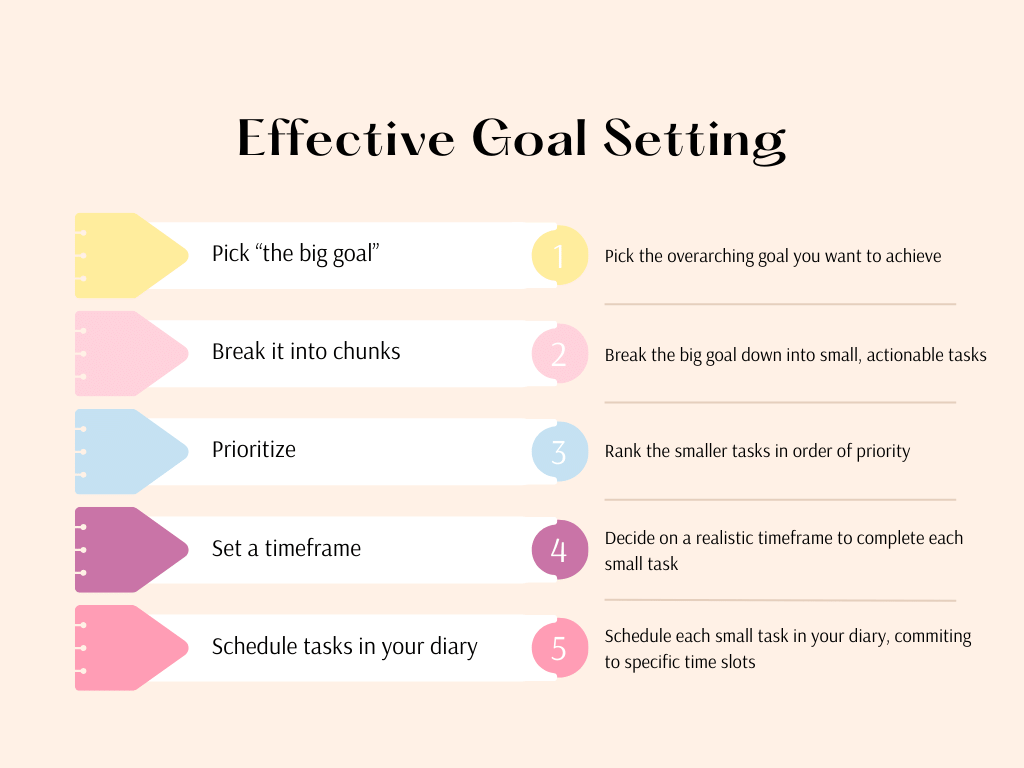
I would recommend you set your photography goals in the following way:
1) Pick “the Big Goal”
First of all, pick the overarching goal.
Let’s say your goal is “create a website for my photography business”.
Write this on a piece of paper.
2) Break it Into Chunks
Next comes a little brainstorming phase:
Define for yourself which tasks this process will contain.
Try to think of all aspects that creating a website would entail.
I could think of the following tasks:
- Research website builders (like WordPress, Squarespace or Shopify) and decide on one
- Decide on a website name and buy the domain
- Think about all the pages your website should include, like “About”, “Portfolio”, “Services”, etc
- Decide on a design direction – what colours, fonts, layout?
- Start watching website builder tutorials and building basic pages of the website
- Write content for the individual pages and add it, such as the “About me” section
- Add photos or graphics, e.g. to the portfolio page
- Set up a newsletter subscription form on the website
…and so on. Keep going until you think you’ve come up with every task necessary to build your website.
3) Prioritize
Now, look at the list…this is already so much more specific and actionable, right?
Well, now you can make it even more concrete.
If you haven’t already, put the tasks in the order in which they should be completed (you can always adapt this later if needed), marking them with numbers according to priority.
4) Set a Timeframe
In the next step, set a timeframe to complete the first task on your list (in my case, “research website builders and decide on one”).
Let’s say you decide that you will complete the website builder research task in one week.
Try to be realistic here – you most likely have other commitments, too, so don’t be overly ambitious with your timeframes, as this will just lead to frustration when you don’t manage to complete the task within the set time period.
Instead, think about what else you have going on that week/month, then set a realistic timeframe considering all your other commitments.
Don’t overstuff your diary – it’s better to plan in a few extra days than to abort the task because you’ve stressed yourself out too much.
I promise to keep this blog completely ad-free so you can read without distractions. If you want to support my work, buy me a coffee: It’s a small gesture that makes a big difference!
5) Commit to Specific Time Slots
Next, get out your diary or open your digital/phone calendar.
It’s now time to decide which days you will work on your task.
Staying with our example, you might enter “research and compare website builders” on Monday evening and Saturday morning in the upcoming week.
If you can, make it even more concrete, for example:
Monday, 7pm-8.30pm
Saturday, 11am-12.30pm
Of course, you don’t know exactly how long you will need for the task, but you can simply estimate the timeframes and schedule in some more slots the week after if needed.
At this point, you may start to feel a little put off, wondering why you have to do so much admin – why not simply do the task at some point in the next days, whenever you have some free time? Why make it so detailed?
Well, it’s because this system works so much better!!!
Trust me, I’ve tried many approaches to accomplishing goals, and this truly is the best one.
It works because something magical happens when you schedule the task in your diary – you basically commit to yourself that you will complete it.
Also, our brains like order and simplicity. It’s very energy-consuming to constantly worry about tasks that need doing and to stress about when you’ll finally start.
Putting the task in your diary means that you don’t have to worry about all that – you only need to “show up” in the allocated time slot and get it done.
The rest of the time, you don’t need to spend any thought on it at all!
This is really freeing and actually less stressful than doing the task ‘whenever you get round to it”, as then it will be constantly on your mind.
Once you’ve completed the task, you can then move on to the next one on your list.
It helps to keep a list of all the subgoals on your desk or somewhere else where it’s visible, so you can cross off one by one. I find this really motivating as you can monitor your progress week after week.
How to Avoid Overwhelm
OK, maybe you’re getting all excited now and want to tackle all your big goals straight away.
However, having been there and done that, I can only advise you to slow down and get strategic, as trying to achieve too many things at once is a surefire way to feel massively overwhelmed.
When it comes to goal setting, I’m not a fan of multitasking.
Trying to tackle too many goals at once is confusing and energy-draining.
Instead, it’s best to work on your goals one by one, if possible.
Of course, some goals can only be accomplished by achieving something else first.
Hence, I suggest you take some time out once every six months or so and make a strategic plan.
Go to a nice coffee shop or find a cosy corner in your home and think about all the things you want to achieve in the near future. Then, rank them in order of priority.
For example, if you wanted to set up an art photography business with your own website, the goals may be:
- Register name and details of your business
- Write artist bio and CV
- Build your own website
- Create a portfolio
- Create a logo/branding concept
- Learn about marketing strategies
- Create a business profile on Instagram, Facebook, Pinterest, etc
- Develop a content strategy for your marketing
- Set up a print shop
- Reach out to galleries
- Organise your own solo exhibition
You can see here that the tasks should happen in a specific order.
For example, it wouldn’t make sense to set up social media profiles when you haven’t even got a name or a branding direction for your business yet.
So, for your strategic plan, put your goals in a logical order and then assign rough timeframes to them, like for example:
- Register name and details of your business – 1 week
- Write artist bio and CV – 2 weeks
- Build your own website – 2 months
- Create a portfolio – 1 week
- Create a logo/branding concept – 4 weeks
- Learn about marketing strategies – 4 weeks
- Create a business profile on Instagram, Facebook, Pinterest, etc – 2 weeks
- Develop a content strategy for your marketing – 1 month
- Set up a print shop – 1 month
- Reach out to galleries – 3 weeks
- Organise your own solo exhibition – 2 months
This is really just an example – tailor this to your own lifestyle and diary.
Once you’ve created the overarching goal timeline, you can start with the first goal, split it into smaller tasks and schedule them in your calendar as described above.
As soon as you’ve completed the first goal, you move onto the next and so on.
This strategy works because:
- You always know exactly what task you’re working on and when
- You have a bird’s eye view of all the goals you want to achieve and know roughly how long it will take you to do so
- You don’t need to worry about doing lots of things at once – you can rest assured in the knowledge that you’re working on your goal list in a logical and efficient manner, without feeling overwhelmed.
And that’s it for today’s post!
Hopefully, you will achieve your photography goals soon with this method 🙂 Let me know in the comments which tip you found the most helpful!