
Abstract Portrait Photography Techniques That Break the Rules
I don’t know about you, but conventional portrait photography can sometimes feel a little repetitive.
With traditional portraits, the goal is usually to present the subject in a recognisable and relatable way.
This is no doubt enjoyable, but it means you’re often tied to certain conventions like typical portrait poses and flattering lighting.
The great thing about abstract portrait photography is that there are no such conventions.
Instead of depicting your subject in a realistic way, you distort, obscure or reimagine it completely, using tools such as motion blur, reflections, or digital manipulation.
That’s one reason why taking abstract portraits can be amazing for your creativity, especially if you’re feeling uninspired and want to inject some new life into your portraits.
I enjoy taking abstract self-portraits because I love how they push creative boundaries and evoke emotion in the viewer.
Also, since you’re not tied to traditional portrait rules, you have a lot of artistic freedom, which is so much fun!
In this post, we’ll dive into the world of abstract portrait photography.
I’ll share some techniques for creating abstract portraits, as well as practical examples to inspire you.
Let’s get into it!
1. What is Abstract Portrait Photography?
So, what exactly is abstract portrait photography?
Simply put, an abstract portrait uses creative techniques to alter or obscure the subject.
To compare, look at this classic portrait photograph, which shows typical characteristics of conventional portrait photography:

You can see that this portrait is focused on traditional representation of the subject (it’s actually a self-portrait, so the subject is me 🙂).
In contrast, look at this abstract portrait photograph:

Here, you can see that the subject is not clearly recognisable because the image was manipulated and distorted.
Typical Elements of Abstract Portrait Photography
There are certain key elements that will transform a regular portrait into an abstract portrait.
Colour, Light and Shade
The first one is the use of colour, light and shadow to create a certain mood or atmosphere:
Photographers may play with light and shade or use a specific colour scheme in order to create a more conceptual look in their portraits.
Blurring or Distortion
The next element is blurring or distortion:
This entails taking (or manipulating) the image so that the facial features are not recognisable anymore, either because they are obscured or distorted.
An example of this would be using motion blur or slow shutter speed for a ghostly effect like in this image:
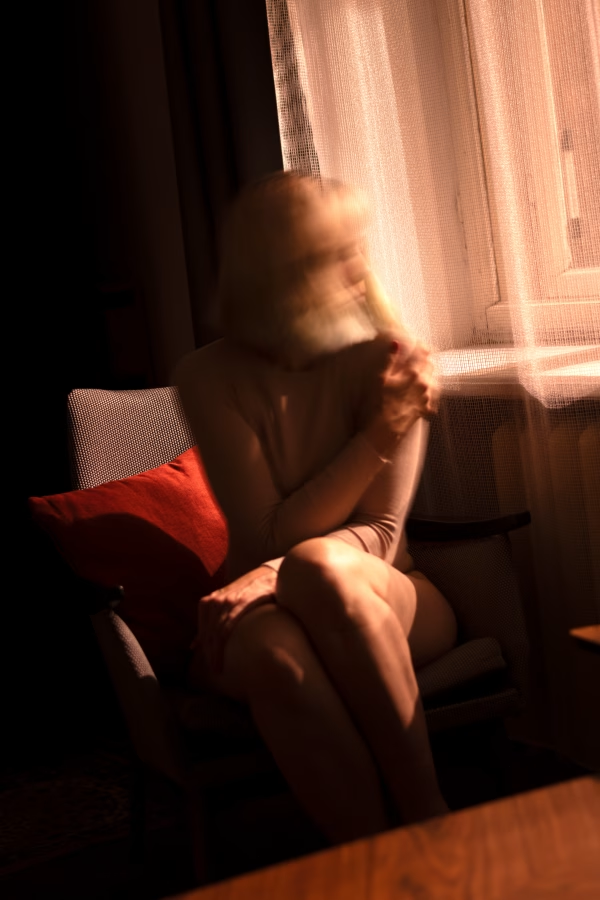
Distortion could be done through tools such as prisms or reflections, for example.
Close-ups and Cropping
Finally, photographers can also create abstract portraits using extreme close-ups or creative crops.
Here’s an example:

Essentially, abstract portrait photography prioritises emotion over realism.
Basically, you’ll want to try and capture a feeling or mood rather than realistically depict the subject.
Let’s now talk about some hands-on techniques you can try to create abstract portraits…but before I get to that, did you know you can download my free portrait ideas ebook?
Free Ebook: 50 Portrait Photography Ideas
If you need fresh inspiration for your portrait photography, download my e-book which contains 50 creative ideas and projects for portrait photography.

But now, back to the blog post!
2. Techniques for Creating Abstract Portraits
The great thing about abstract portrait photography is that there are so many ways to approach it.
Here are some fun and easy techniques you can try to create abstract images:
2.1 Reflections and Refractions
Reflection and refraction (i.e., the bending of light) are among my favourite tools for creating abstract portrait photography.
They work really well because they distort the subject, resulting in a very surreal effect.
Here are some ways you can achieve reflection/refraction:
Use Mirrors
If available, use multiple mirrors to reflect different angles of the subject’s face.
This can give you a very kaleidoscopic, fragmented effect, like in this picture:

Shoot Through Glass
Next, you can try taking your portrait through either a window or a transparent object:
The reflections from surrounding elements will be visible in the shot, creating a more interesting composition.
You can also spray or apply a liquid to the glass, like water or Vaseline.
I saw somebody use aloe vera gel in a YouTube video recently, and the effect was really cool!
Here’s an example:

Finally, check out the photographer Henri Senders here:
He uses dirty, corroded or damaged pieces of glass and other surfaces to give his portraits a magical fairytale look.
Use Water Reflections
Use puddles, lakes, or even a bowl of water to capture distorted reflections of your subject.
Shoot Through a Prism
Another fun thing to try is holding a small prism before your lens.
These are little objects made from glass or plastic that bend light in unexpected ways, adding interesting distortions and reflections to your portrait.
By the way…if you enjoy taking portraits, you may be interested in my free cinematic portrait challenge:
Free 7-Day Cinematic Portrait E-Mail Challenge!
Do you want to master cinematic portrait photography in seven days? Then sign up for my free email challenge with a different creative prompt every day!

But now, back to even more techniques for abstract portrait photography.
2.2 Motion Blur and Long Exposure
Motion blur and long exposure techniques are great tools for abstract photography, as they help you create fluid images that capture motion or convey a ghostly effect.
Here are some ways to achieve motion blur:
Slow Shutter Speed
Set your camera to a shutter speed of 1/10 sec or slower.
Ask your subject to move their head, hands, or entire body while taking the photo, creating a blurred effect.
Intentional Camera Movement (ICM)
This is a super cool technique where you move the camera slightly while the shutter is open.
This can add a very artistic feel to the portrait, similar to an impressionist painting.
Multiple Exposures
You can also try combining multiple frames in-camera or in post-processing, resulting in a very dreamlike effect:

These techniques are perfect for expressing emotions such as nostalgia, mystery, or unease in your abstract portraits.
Thank you for reading this post. If you want to support my blog, buy me a coffee: It’s a small gesture that makes a big difference!
2.3 Unconventional Lighting & Shadows
Light and shadows can sculpt, obscure, and distort, making them a great stylistic device for abstract photography.
Start with strong directional lighting:
Try a single bare bulb or a flashlight to create strong, harsh shadows that break up the face into geometric shapes.
You can also place your light source low, high, or to the side of the subject to achieve very dramatic contrasts and interesting shapes.
Lighting from below, especially, gives you a very unnatural look (as we don’t often see this in nature).
Hence, it can be great for a very bizarre, outer-worldly effect.
Using Coloured Light
Next, I love using coloured light for my abstract self-portraits.
Here’s an example:

To achieve this effect, I used a coloured gel, i.e. a sheet of heatproof plastic.
By placing gels over your lights (or even your camera lens), you can add unnatural colours that evoke specific emotions and make the image more interesting.
Try mixing opposing hues like cyan and red, or use monochromatic tones for moodier effects.
2.4 Unusual Perspectives and Cropping
Perspective plays a big role in how the viewer understands your image.
In abstract portraiture, choosing a non-traditional viewpoint can make a familiar subject look strange or mysterious.
For example, try tightly cropping or shooting from an unconventional angle.
You can also focus on isolated body parts, such as a shoulder curve, a close-up of an eye, or fingers resting on fabric.
These tight crops can almost look sculptural when you remove them from the context of the whole body.
A close-up of lips, for instance, can appear like a landscape, especially with soft focus and intentional blur.
Also, think about angles:
You could capture a face upside down or from behind, for example, to challenge the viewer’s expectations and make the portrait feel unfamiliar.
You could even play with perspective distortion using wide-angle or fisheye lenses to compress or exaggerate features (more on that later).
2.5 Post-Processing and Digital Manipulation
Finally, you can use digital tools to create super cool abstract portraits.
Using programs like Photoshop, Lightroom, or even AI-based software, you can manipulate your images and introduce surreal effects.
Colour Grading
One method you can try is colour grading:
By shifting hues and tones, you can often change the entire look and feel of a portrait.
Try desaturating everything but one colour or using unexpected palettes—such as deep purples or neon greens—to create a feeling of unease or fantasy.
I also really love using overlay textures—like scratched film, cracked paint, or smoke—to make my images look more abstract.
You can find these in image stock libraries like unsplash.com or even create them from your own photographs.
When adding these textures to your photos in Photoshop, use different blend modes to make the texture layer better interact with your portrait.
Another fun thing to try is using Warping and Liquify tools to bend, stretch, and reshape your subject.
You can elongate the neck, twist facial features, or make the entire portrait ripple like it’s underwater.
These distortions are great for communicating psychological themes, dream states, or emotional tension.
Next, AI-based tools like generative fill or neural filters can give you even more creative possibilities, like transforming the image into a stylised painting or fantasy landscape.
I haven’t played around with this much, but you’ll find these tools in all big photo editing software programmes, and there’s a lot of fun to be had with those!
I recently started a course on digital manipulation using AI and highly recommend it. You can find it here.
In the final section, I will share some helpful tools and equipment for abstract portrait photography.
3. Equipment and Tools for Abstract Portrait Photography
You definitely don’t need to buy any particular gear—you can create super cool abstract portraits even using camera techniques and household tools, as described above.
However, if you want to take things a bit further, you can try some of the following lenses, filters and accessories for even more creative effects.
3.1 Best Lenses for Abstract Portrait Photography
For traditional portraits, photographers often use 50mm or 85mm lenses.
That’s because these lenses give you a very natural perspective and flattering compression.
In contrast, in abstract portraiture, you’re actively trying to achieve distortion and close focus, which is why the following lenses might be a better choice:
Macro Lenses
Macro lenses are made for capturing details and close-ups.
Therefore, they allow you to isolate texture, skin, or individual features like eyelashes, pores, or fingertips.
Try using a macro lens to transform your subject’s body into a strange landscape or blur the line between subject and object.
A good choice is a 100mm macro lens, as it will also give you a beautiful depth of field.

Wide-Angle Lenses
Wide-angle lenses (typically 24mm or wider) are great for exaggerating facial features and creating surreal perspectives, especially if you shoot up close.
Wide-angle lenses distort proportions and stretch space optically, which can make the subject appear elongated or fragmented.
Try using a wide-angle lens if you want to experiment with unusual angles or incorporate the surroundings or reflections into the composition.
Other Lenses
Some other lenses perfect for abstract portraiture are tilt-shift lenses and Lensbaby lenses; these will introduce creative blur, selective focus, or warping effects.
3.2 Filters and Accessories
Creative Filters can add texture and light manipulation directly in-camera.
I really love prism or kaleidoscope filters.
You can attach these to your lens to bend and split light, creating rainbow streaks and reflections.
Another handy tool is variable ND filters:
These allow you to extend your shutter speed in bright light, enabling long-exposure motion blur during daytime shoots.
Glass and Acrylic Accessories
The next option is glass and acrylic tools, such as handheld prisms, beveled glass, or even clear plastic, that you place in front of your lens.
These elements create natural refractions and soft-focus areas that can look very interesting in portraits.
The great thing about abstract portrait photography is that anything goes.
You can try some or all of the options above, but you can also experiment with whatever you have at home.
Place unusual objects in front of the lens, use a scanner, use a film camera and expired film…just have fun and see what happens!

Thank you for this
Thank you for reading! You’re super welcome 🙂