
As a self-portrait artist, I often use photography backdrops in my photos because I love the clean, artistic look they provide.
Over the years, I’ve tried many different types and materials, and I’ve noticed that some photography backdrops are more suitable than others, for example, because they are easier to clean or require no ironing.
For today’s post, I thought it would be helpful to give you an overview of the best photography backdrops for self-portrait, portrait, and fine-art photography.
The article is split into two parts:
- an in-depth backdrop analysis with advantages and disadvantages of each backdrop type
- a handy shopping guide with my favourite backdrops.
(Click here if you want to jump straight to the shopping guide).
Let’s get into it!
(Just so you know: This post contains affiliate links. As an Amazon Associate and partner of other affiliate programs, I earn from qualifying purchases).
Part I: Photography Backdrops: An In-Depth Guide
When it comes to photography backdrops, you actually have quite a few different options.
In the following sections, I will share the most common types of:
- Backdrop Stands/Mounting Systems
- Backdrop Materials
I will also list the advantages and disadvantages of each category so you can make an informed decision when shopping for your photography backdrop.
1) Backdrop Stands and Mounting Systems
Let’s first look at the different types of photography backdrop stands and mounting systems.
Overall, there are four main types of backdrop systems to choose from:
A. Wall- or ceiling-mounted
B. Free-standing support system
C. Panoramic backdrops
D. Foldable/collapsible backdrops
Read about each type’s features, advantages and disadvantages in the following sections.
A. Wall- or Ceiling Mounted
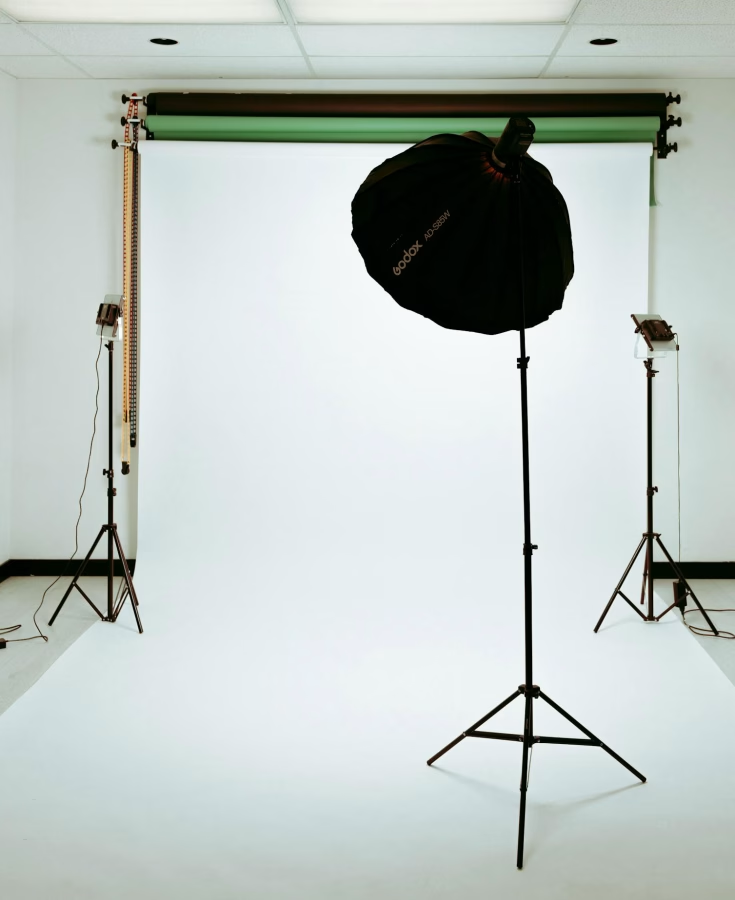
This type of backdrop system is often found in professional photography studios, but it can also be easily mounted in your home.
It works by attaching one or several metal or plastic rollers with rolled-up backdrops to your wall or ceiling.
As soon as you need to use the backdrop, you lower the material using either a manual system (cheaper) or an electrical system (more pricey).
Here’s a picture of a wall-mounted backdrop system:
Advantages
Saves Space
The main advantage of this kind of backdrop system is that they save a lot of space! You can store the backdrop neatly rolled up and lower it when needed.
Keeps Backdrop Clean and Crease-Free
Another huge advantage of roller systems is that the backdrop doesn’t crease during storage because it’s rolled up.
This also means it doesn’t get dirty as quickly as other backdrops, which can gather dust or become stained during storage.
Doesn’t Require Assembly and Disassembly
Wall-mounted backdrop systems only need to be installed once and can be used whenever needed.
I currently use a backdrop support system in my home studio, and it’s a little annoying because I constantly have to set it up and then tidy it away again.
It would be much easier to install a ceiling or wall system once and then raise the backdrop when not in use.
Disadvantages
Requires Installation
The first disadvantage is that this kind of system requires proper installation when you first set it up.
If you’re not a DIY person, you may need someone to help you mount the rails on the wall or ceiling.
Can’t Be Moved Once Installed
Another disadvantage of these backdrop systems is that you can’t move them once they’re installed (unlike a free-standing backdrop), which makes them less flexible.
B. Free-Standing Photography Backdrops Support System
Let’s talk about the next backdrop type: backdrops mounted on a free-standing support system.
This sounds way more complicated than what it actually is – a metal crossbar placed on two tripod stands.
Here’s a photo:

The metal bar that supports the backdrop may be fixed length or extendable (telescopic).
The latter is, of course, handier because you can adjust the support system depending on your home or studio space.
This is the kind of backdrop system I’m currently using in my home studio.
Advantages
Flexibility
The first big advantage of free-standing support systems is that they’re so flexible.
You can set them up wherever you want, carry them to different locations, etc.
Plus, if you buy a system with a telescopic crossbar, you can extend the length and adapt it to your space.
No Installation Required
The next advantage is that this kind of system requires no installation – you simply set it up and dismantle it after use.
Disadvantages
Less Stable
Depending on the quality of your background support system, this type of backdrop stand can be a little flimsy:
I’ve had mine topple over a few times because the tripod stands aren’t the best quality.
Also, someone could knock them over – since the system is not mounted to anything, it’s not as stable.
More Hassle
My big gripe with these kinds of stands is that they have to be assembled and disassembled for every use if you use them in a home studio.
In a professional studio, you can, of course, simply leave them set up.
However, if you use this system in a home studio, it takes up much more space than a wall- or ceiling-mounted system.
Hence, you’ll probably need to disassemble it after every shoot and store it out of the way.
C. Panoramic Photography Backdrops Stand
The next backdrop option is a panoramic backdrop system. These usually combine a metal frame with a three-panel backdrop – you can see one here.
Advantages
Flexibility
The main advantage is that these backdrop stands are flexible – you can set them up wherever you want, carry them to different locations, etc.
Large Surface Area
Since these backdrop stands consist of several panels, they are often wider than other backdrops, meaning they’re great for photographing groups or simply creating a more spacious set.
Disadvantages
Higher Price Point
This type of backdrop system can be more expensive than the standard free-standing ones, so it can be a bit of an investment.
Takes Up More Space
Unless you assemble and disassemble the backdrop every time, which can be a hassle, these photography backdrops take up quite a bit of space and may not be suitable for a small home studio.
D. Foldable/Collapsible Backdrop
Finally, you can buy a foldable/collapsible backdrop.
They’re often double-sided and may have loops for hanging them up (otherwise, you can lean them against something or have an assistant hold them).
Advantages
Portability
The first advantage of collapsible backdrops is that they’re portable:
You can collapse them and carry them wherever you want, which makes them great for outdoor and on-location shoots.
Disadvantages
No Mounting System
These backdrops don’t have an integrated mounting system, so you either have to lean them against something, have an assistant hold them, or use the attached loops to hang them up.
Small Surface Area
Another disadvantage is their small surface area.
They’re great for headshots but may not be suitable for full-body shots with some space around the model.
Design Limitation
The last disadvantage of these backdrops is that you’re limited in terms of design:
With a roller-mounted system, for example, you can buy different rolled-up backdrops and mount them.
With these collapsible backdrops, you get one design per backdrop, so if you want other designs, you have to buy a whole new one each time.
Now that we’ve looked at different backdrop stands and mounting systems, let’s move on to backdrop types and materials!
Before I get to the next section…do you enjoy taking portraits? Then you might like my free ebook (more info below):
Free Ebook: 50 Portrait Photography Ideas
If you need fresh inspiration for your portrait photography, download my e-book which contains 50 creative ideas and projects for portrait photography.

…but now, back to the blog post!
2) Photography Backdrop Types/Materials
Types of Backdrop
First of all, you can get backdrops in the shape of:
- a roll (can be used either for wall-/ceiling-mounted or for free-standing backdrop supports)
- a single sheet (usually attached with clamps to your backdrop support system)
- a rigid board, usually made from PVC (can be leaned against something or used for flat lays, making it the ideal choice for product photography backdrops)
Which one of those you choose depends on your backdrop support system and your general preference.
I personally use sheet-type backdrops because I can easily clamp them to my free-standing support system.
However, in the long term, I plan to upgrade to a wall-mounted backdrop system with rolled-up backdrops because it will be easier to keep the backdrop clean and crease-free.
Backdrop Materials
There are many different backdrop materials available. Here are some of the most common:
Seamless Paper Backdrops
Seamless paper is a great choice for the studio because it has a smooth surface and comes in a wide range of colours.
It’s easy to set up and can be easily replaced when it gets dirty or damaged.
Muslin Backdrops
Muslin backdrops are made from a durable material (mostly cotton) that is often hand-painted or dyed in various patterns and designs.
They provide a soft, textured look that adds depth to photos.
Vinyl Backdrops
Vinyl backdrops are great for outdoor shoots or events where the backdrop may need to withstand rain or wind.
They come in a variety of colours and patterns.
Canvas Backdrops
Canvas backdrops, with their textured surface and matte finish, offer a more traditional look. They are great for fine-art portrait and self-portrait photography.
Green Screen Backdrops
Green screen backdrops allow you to digitally insert any background you desire during post-processing using chroma key technology.
Custom Printed Backdrops
If you’re looking for a particular type of backdrop but can’t find it in the shops, you can order a custom printed backdrop for your shoot.
DIY Backdrops
Of course, you can always create your own backdrop – I’ve done this in the past by painting a matte foamboard with acrylic paint.
This is a great option if you want to achieve a painterly effect in your photo.
Extra Tip for Choosing Photography Backdrops:
Ideally, try to buy photography backdrops that don’t crease (like seamless paper that you can roll up, or special crease-free microfibre backdrops).
If that’s not possible, make sure to iron your backdrop before the shoot – it’s really worth the effort as removing creases in Photoshop is a real pain!
Part II: Photography Backdrop Shopping Guide
The following section contains a summary of the best photography backdrops for your self-portrait, portrait, fine art or product photography.
1) Wall-Mounted Backdrop Support Systems
Here are some recommended wall-mounted backdrop support systems for your home or studio:
NEEWER Photography 3 Roller Wall Mounting Background Support System
If you prefer shopping off Amazon, try the Impact Wall Mounting Kit from B&H Photo:
Electric Option:
You can also get an electric mounting system, which lets you lower the backdrops with the included remote.
These are pricier, but a nice investment since they’re much more comfortable to use!
2) Free-Standing Backdrop Support Systems
I personally love free-standing backdrop systems, and it’s what I use in my studio.
Here are some great options:
3) Collapsible and Panoramic Backdrops
Here are some of my favourite collapsible and panoramic backdrops for your studio:
Neewer Chromakey Foldable Backdrop with Stand
Or try a similar model by Impact, available at B&H Photo:
If you’re UK-based, also check out these collapsible backdrops by Godox, which have a beautiful fine art look:
Best Backdrops
In the next section, I’ve compiled some backdrop options made from different materials.
Best for Fine Art/Portrait Photography
My overall favourite backdrop brand for my fine art self-portraits is Kate Backdrop.
I just love their products – they have a huge selection in general, and they also do a lot of beautiful art backdrops that look like painted canvases.
The product below is just one example – you will find lots more in their Amazon shop or on their website HERE.
Best Seamless Paper Backdrop (Sold in Rolls):
I LOVE the seamless paper backdrops by Savage…they’re great quality and available in a huge range of colours:
If you’re in the UK, a similar product in terms of price point and quality is Calumet:
Best Backdrop for Product/Food Photography:
For food or product photography, I’d recommend the backdrops by Selens that can easily be wiped or cleaned:
Green Screen Backdrop:
And finally, here are some great green screen backdrop options:
And that’s it for my photography backdrops shopping guide!
If you’re also interested in getting other gear for your home studio, check out this post here for more tips and recommendations!
I promise to keep this blog completely ad-free so you can read without distractions. If you want to support my work, buy me a coffee: It’s a small gesture that makes a big difference!